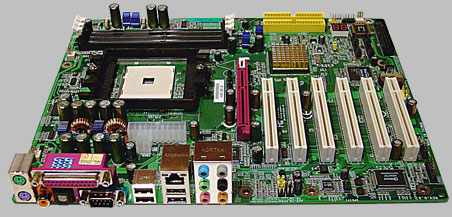

Manufacturer EPoX
Name EP-8KDA3+
Type / Chipset Socket 754 / nVidia nForce3 250 Gb Chipset
Dimensions
+++ 19 mm (54 mm radius) around the socket to the next capacitor or other parts of the mainboard - for further information see Fit for Fan.
The overall size is 305 x 245mm.
Slots +++ 6x pci, 1x AGP (1.5V 4x/8x), 3x DDR PC1600 - PC3200 (max. 3GB RAM)
Connectors

+++++ 1x Floppy, 2x UDMA133, 6x SATA150 (4x RAID 0/1/10/5), 2x serial (1x internal),
1x parallel, 2x PS/2, onBoard 10/100/1000 Mbps base-T Ethernet, 8x USB 2.0/1.1
(4x internal/optional), 1x Gameport (incl. mounting bracket), 8-Channel AC'97 RealTek ALC850
onboard 6x connectors (2x int. Aux, 1x ext. S/PDIF, ext. Line in, ext. Mic, ext. front out,
ext. Side out, ext. Rear out, ext. Center/Subwoofer), WakeOnLan and 3x Fan connectors.

Vcore +++ BIOS between 1,55 Volt and 1,7 Volt in steps of 0,05 Volt / Jumper not available
Multiplier ++++ BIOS between 8x and 20x / Jumper not available
FSB ++++ BIOS between 200 and 250 MHz / Jumper not available
VIO/VDD ++++ VAGP between 1,5 - 1,8 Volt, VDDR 2,5 - 2,8 Volt, VNB 1,6 - 1,75 Volt
Performance**** ++++ Ratings with HIS Excalibur Radeon 9600 Pro graphic card and Catalyst 3.6 !
AMD Athlon 64 3200+ 3802 points with 3DMark 2003
Manual and
Labeling
++++ Complete and easy readable mainboard labeling, a detailed manual in englisch and an additional fast installation guide.

Overall

++++ The EPoX 8KDA3+ costs about 150 Euro (10/2004) where it is within the upper range of
the current Socket 754 mainboards.
However, in view of the fantastic equipment, the numerous features and the very good overclocking
behavior the price isin any case justified.
Not only that EPoX attaches 2 S-ATA cables, 2 S-ATA power cables, 2 rounded IDE cables,
2 mouning brackets for IO and USB, an ATX bracket, etc. to the mainboard, they also offer a
small screwdriver multi tool with this board.
This is to divert however by no means from the features of the board, but shows the
high quality rating, which EPoX would like to represent us with this nForce3 mainboard.
And I have to say, I was very astonished about the 6 x Serial ATA connectors and
altogether 6 x 3,5mm jacks for the 8 channel sound.
Here's a picture of the 4 of the 6 S-ATA connectors, those over the Silicon Image Sil3114
controller are headed for and with EPoX usual 7-Segment postcode digits:

In addition, the overlocking features do not come too briefly, it's possible to adjust the most
important voltages e.g. the Vcore (CPU voltage), videocard, chipset and memory voltages
over the BIOS.
The multiplier, the frequencies for the chipset and/or the videocard is also alterable via BIOS.
To prevent overheating of the nForce3 chipset during overclocking, it became a passive heatsink
and as rather unusual feature there're small heatsinks on the most important Mosfets and
voltage regulator components, like the one here on the following Picture:

However, the whole heatsink trouble should also give us a high overclocking potential and of course
a high speed and the test confirmed the so far highest benchmark result of all tested Athlon 64
mainboards.
Besides I got also the highest overclocking value with the 8KDA3+ and that A64 3200+ CPU,
so it's really difficult to find only one negative point in the review of this board.

Conclusion: EPoX succeeded with the EP-8KDA3+ Socket 754 mainoard a genuine achiever,
starting with the scope of supply over the technical equipment up to the great overclocking features
really no desires leaves open !
Even the board layout and the bench mark of values could convince, therefore it's a pleasure for
me to give this board the so far highest Socket 754 mainboard award.
The EPoX EP-8KDA3+ receives the first Athlon 64 "ocinside.de OverClocking Dream 2004 award"
and there is no question, this mainboard have to be shortly in my main-PC.

Hereby I would also like to thank EPoX for their support.

Picture

**** All Socket 754 mainboard tests since 01.08.2004 are based on an AMD Athlon 64 3200+ with a HIS Excalibur
Radeon 9600 Pro graphic card, Kingmax 256 MB PC2700 memory module and the following software configuration:
Windows 98 SE, DirectX 9b, Catalyst 3.6 graphic driver and 3DMark 2003.
Since all benchmark results should only offer a comparison among themselves, I select Win 98 SE for a faster OS installation which is of course not the usual OS for Athlon 64 systems but enough for a comparison.


Back to the Mainboard comparison !