
Manufacturer EPoX
Name 8NPA SLI
Type / Chipset Socket 754 / nVidia nForce4 SLI Chipset
Dimensions
+++ 24 mm (56 mm radius) around the socket to the next capacitor or other parts of the
mainboard - for further information see Fit for Fan.
The overall size is 305 x 225mm.
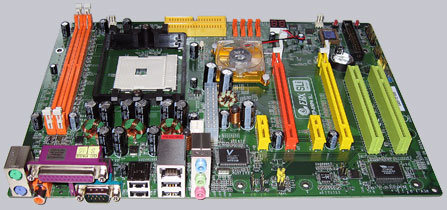
Slots - 2x pci, 2x PCI Express 2x16/2x1, 2x DDR PC2100 - PC3200 (max. 2GB RAM)
Connectors

+++ 1x Floppy, 4x UDMA133, 4x SATA II RAID 0+1, 1x serial, 1x IrDA, 1x parallel, 2x PS/2,
onBoard 10/100/1000 Mbps base-T Ethernet LAN (Vitesse 8201 phy),
10x USB 2.0/1.1 (6x internal, Slot bracket for 2x int. is included),
6-Channel AC'97 RealTek ALC655 onboard with 3x 3.5 mm connectors
(ext. S/PDIF Out, 1x int. Aux, 1x optional int. S/PDIF, ext. Line out, ext. Line in, ext. Mic) and
3x fan connectors + 1x NB fan.

Vcore + BIOS between -0.20 Volt and +0.05 Volt (1.30 Volt - 1.55 Volt)
Multiplier ++++ BIOS between 4x and 25x (max multi depends on used CPU) and 1x to 5x HT
Host Frequency ++++ BIOS between 200 and 450 MHz (PCIe 100 - 150 MHz)
VIO, VDD, etc. +++ VDDR 2.50 - 3.20 Volt / Chipset 1.50 - 1.80 Volt
Performance**** ++++ Benchmark ratings with AMD Athlon 64 3200+ Socket 754 Processor.
1x Gigabyte GV-NX66T128VP Nvidia 6600 GT PCIe graphic card: 8329 points with 3DMark 2003
2x Gigabyte GV-NX66T128VP Nvidia 6600 GT PCIe graphic card: 14279 points with 3DMark 2003
Manual and
Labeling
++++ Very well readable, complete motherboard inscription and a very detailed motherboard
manual in English.

Overall

++++ The EPoX 8NPA SLI Socket 754 PCIe SLI cost at present approx. 95 Euro (01/2006)
and is appropriate thereby in the middle price segment of all still tested Socket 754 mainboards.

The EPoX EP-8NPA SLI Socket 754 motherboard is the first Socket 754 board in the test,
which is equipped with the nForce4 SLI chipset like current Socket 939 boards and even with
two PCIe 16x video card Slots.
The company EPoX makes it possible with this Socket 754 motherboard of the newest generation
to build extremely inexpensive PC systems with high performance, e.g. based on an AMD Sempron
S754 CPU and 2 favorable PCI Express video cards in SLI mode.
This is rather unusual, because so far it was unfortunately only reserved for Socket 939
processors to work at the same time with two PCIe video cards.

The more pleasing the outstanding benchmark results, those keep up with the benchmark results
of current Socket 939 PCIe SLI boards.
Under the current test conditions the board with the Athlon 64 3200+ S754 CPU was clearly
faster than other Athlon 64 3000+ S939 systems with the same video cards.
The performance is thus really awesome!

We come now to the equipment, which the EP8NPA SLI Socket 754 motherboard has to offer.

As already mentioned in the last PCIe Reviews, the space is unfortunately quite scarcely
on boards equipped with 2 PCIe 16x cards, so that there're also on this 8NPA SLI board only
2 pci card slots available.
A small deficiency is besides that there're unfortunately only 2x 184-Pin DDR memory sockets,
however nevertheless they can be equipped with up to 2 GB memory.

But the board has to offer several positive characteristics ...
The nVidia nForce4 SLI chipset manage four S-ATA II RAID (0/1/0+1) connectors with up to
3 GB/s data-rate and 2 connectors for up to 4 UDMA 133 hard disks.

As sound chip EPoX uses the 6-channel ALC 655 chip, which is able to give support for
up to 6 sound channels with 3x 3.5mm connectors.
Besides EPoX use the Vitesse 8201 LAN chip instead of the integrated 10/100 NIC,
which provides up to 1 Gigabit network speed and is thus optimally for a fast home network.


Here's a picture of a further EPoX characteristic. They offer beside the post code display
(to examining possible starting errors) recently still 2 buttons for Power and Reset:


The two buttons for power and reset are naturally optimal with work in the PC case,
since one thus doesn't have to attach any frontpanel cable to switch on the PC system.

In the BIOS there are some interesting options, because among an easy adjustment of the Vcore
(CPU voltage), VDDR (memory voltage) and Chipset voltage there're by far the most extensive
memory settings.
The performance of the used memory modules can be adjusted hereby optimally.

Naturally the SLI board got also an extensive overlocking check, since particularly EPoX
motherboards are predestinated for overclocking.
Who's somewhat sceptical to overclock a Socket 754 nForce4 board, won't have to worry,
because in the test the HT reference clock could be raised stably on sayful 320 MHz.
And this succeeded in the test even without rising the chipset voltage!
The active chipset heatsink/fan provides a good heat dissipation of the quite cool nForce4 chipset,
whereby a stable system is durably ensured.
Who inadvertently go over the top of overclocking, can trust in the integrated monitoring of the boot procedure, which set automatically all Frequencies and divisors to default values if there's
an incorrect PC start.
And with a watchful view to the 7-Segment postcode debug display one can immediately
recognize the overclock difficulty.

Result: The EPoX EP-8NPA SLI Socket 754 PCI Express motherboard offers owing to the
two 16x PCIe video card slots also with inexpensive processors like an AMD Sempron CPU
an awesome performance.
Besides the EPoX motherboard offers good overclocking features and can be overclocked highly
by asynchronous clocking of the PCIe cards, memory modules, etc.
The equipment is except the 2 DDR memory slots good and offers 4 RAID 0/1/0+1 capable
S-ATA II connectors, 6 channel sound chip and a fast Gigabit LAN.
Altogether this SLI board gives the Socket 754 a completely new meaning and an ample scope for
new AMD PC system combinations.

Special thanks to EPoX for their support.

Picture

Click to enlarge !

Click to enlarge !


**** All Socket 754 motherboard reviews since 01.11.2005 are based on an AMD Athlon 64 3200+ processor,
1x (or SLI systems with 2x) Gigabyte GV-NX66T128VP Nvidia 6600 GT PCI Express video cards and the
following software configuration:
Microsoft Windows XP SP2, DirectX 9.0c, Forceware 81.85 video driver and 3DMark 2003.
All benchmark results should only offer a comparison among themselves.

Back to the Athlon 64 Mainboard Review comparison !