

The technical data …
MX-4 and MX-6 were added for comparison purposes with Arctic thermal pastes. However, attentive readers will notice that MX-5 is missing. This product has already been discontinued by Arctic.
| Description | MX-4 | MX-6 | MX-7 |
| Thermal conductivity | k.A.* | k.A.* | k.A.* |
| Viscosity | 31,600 Poise | 45,000 Poise | 35,000-38,000 Poise |
| Density | 2.5 g/cm³ | 2.6 g/cm³ | 2.9 g/cm³ |
| Temperature range | -50 to +150 °C | -50 to +150 °C | -50 to +250 °C |
| Electrically conductive | No | No | No |
| Throughput resistance | 3.8 x 10¹³ Ohm-cm | 1.8 × 10¹² Ohm-cm | 1.7 × 10¹² Ohm-cm |
| Breakdown voltage | k.A. | 7.5 kV/mm | 4.2 kV/mm |
| Color | Grau | Grau | Grau |
*Arctic has deliberately chosen not to specify a concrete thermal conductivity value for its thermal pastes, stating only that the thermal conductivity of MX-7 is higher than that of its predecessors.
The reason for this lies in the industry itself: some manufacturers work with values that are not very meaningful, making a real comparison almost impossible. Instead of participating in this numbers game, Arctic completely refrains from providing such information, thus setting an example of honesty and technical integrity. From an editorial point of view, this approach is understandable and consistent. In practice, it has been shown time and again that theoretical thermal conductivity values allow little conclusion to be drawn about the actual temperature behavior in the system. Rather, factors such as consistency, long-term stability, and the actual distribution of the paste between the heat spreader and the cooler are decisive—aspects that Arctic specifically addresses with the MX-7.
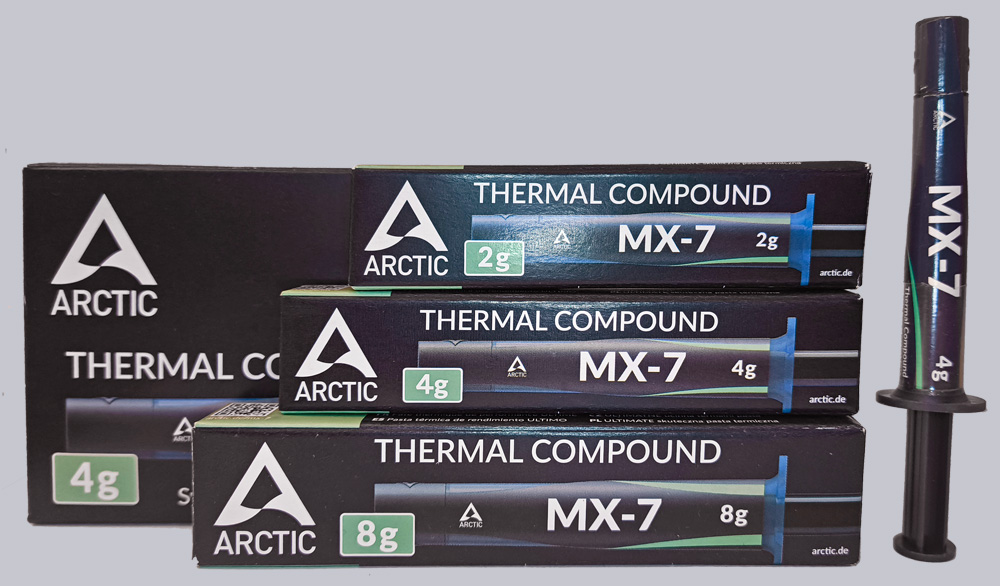
Arctic MX-7 Layout, design and features …