

Practical testing …
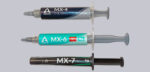
Experience with the thermal paste. The new tube design immediately stands out positively. It appears to be of significantly higher quality than its predecessors. When applying it, we also had the impression that the MX-7 is easier to dispense than its predecessors, especially in comparison to the MX-6. The new viscosity is also a positive feature.
The slightly more liquid consistency offers the advantage that MX-7 spreads well even with lower contact pressure. There are also advantages when it comes to disassembly: With MX-6, especially with the previous AM4 socket, care should be taken to slightly twist the cooler before removing it, as otherwise there is a risk of pulling the processor out of the socket. This risk also exists with the MX-7, but it is significantly lower. However, with Intel’s LGA sockets and an AMD AM5 socket, this can no longer occur thanks to the improved locking system.
The test system consists of the following components:
| Component | Model |
| Motherboard | ASRock B650 Steel Legend WiFi |
| CPU | AMD Ryzen 7 7700 |
| Cooler | Endorfy Navis F360 ARGB |
| Graphics card | KFA2 Nvidia GTX 1070 EX |
| RAM | Kingston Fury 2×16 GB DDR5 6000 MT/s |
| SSD | Samsung 850 Evo 500 GB |
| Case | NZXT H7 FLOW RGB 2024 |
| PSU | NZXT C1500 ATX 3.1 |
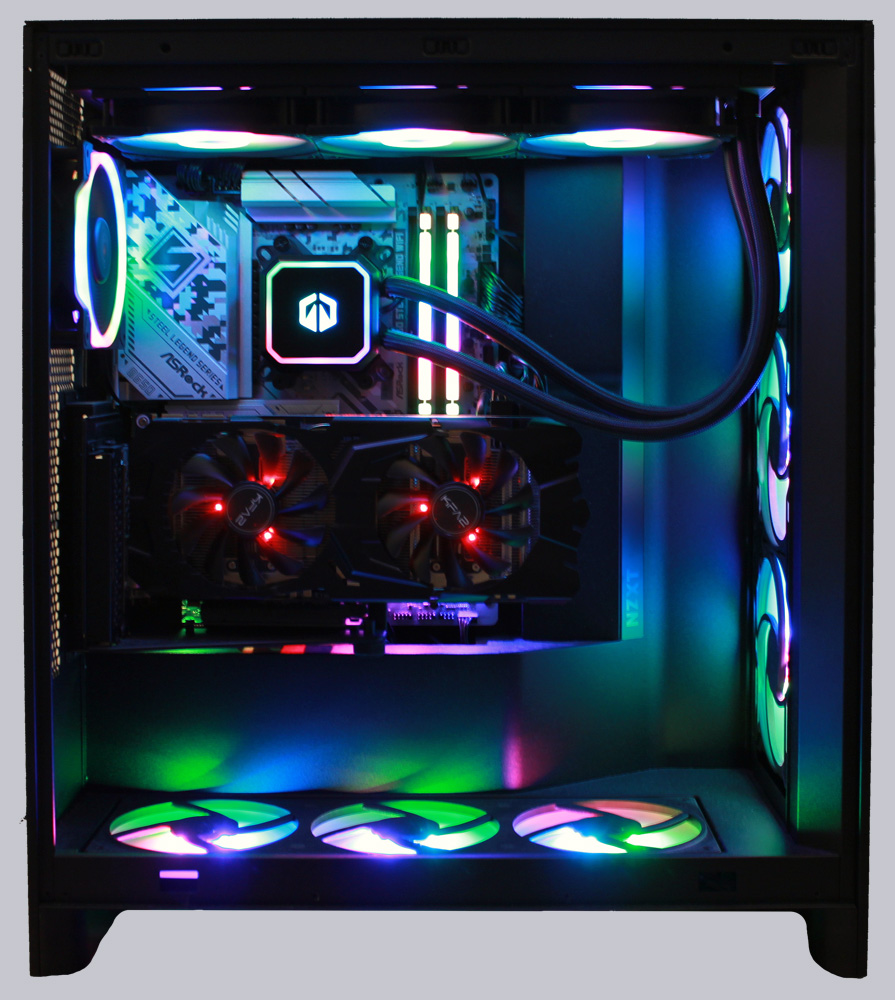
Our test system with AMD Ryzen 7 7700 was used for the thermal paste comparison test. It was overclocked to a constant 120 watts to generate sufficient heat and ensure good comparability. This adjustment was made using PBO. In addition, the maximum temperature was set to 95 °C to allow sufficient leeway for the test. During the test, we also monitored the CPU to ensure that it was constantly consuming 120 watts, as determined by HWiNFO.
Review of the with Prime95 in the “Small FFT” setting. All tests had a warm-up time of 10 minutes to heat the water in the AIO, followed by a test time of 10 minutes. The average and maximum temperatures of the Arctic MX-4, Arctic MX-6, and Arctic MX-7 were determined. All fans in the system were set to 25%, 50%, 75%, 100%, and the ASRock Silent profile as the fan profile. The AIO pump ran continuously at 100%, which is nevertheless almost inaudible with the Endorfy Navis F360 AIO.
First of all, we would like to mention that we tried to create as uniform test conditions as possible. Winter offers the advantage that the room temperature can be easily controlled. A room temperature of 20 °C was targeted for all tests. The paste was applied using the X method to ensure comparability.
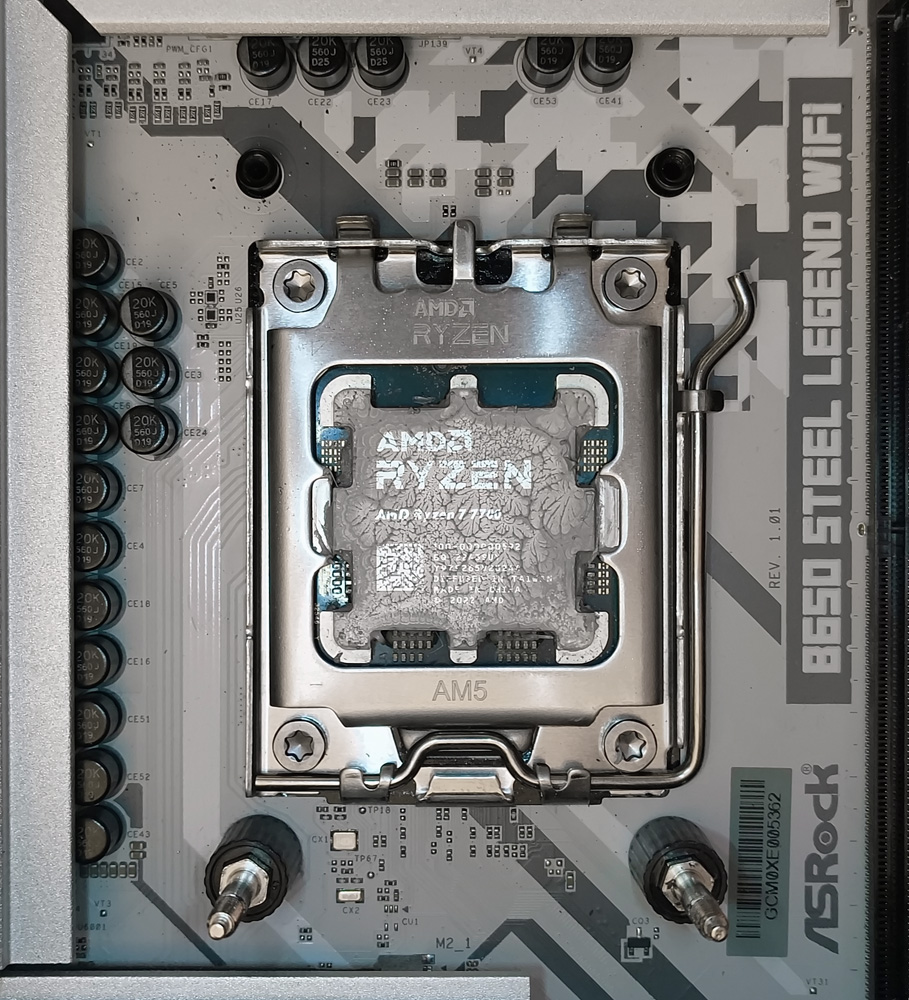
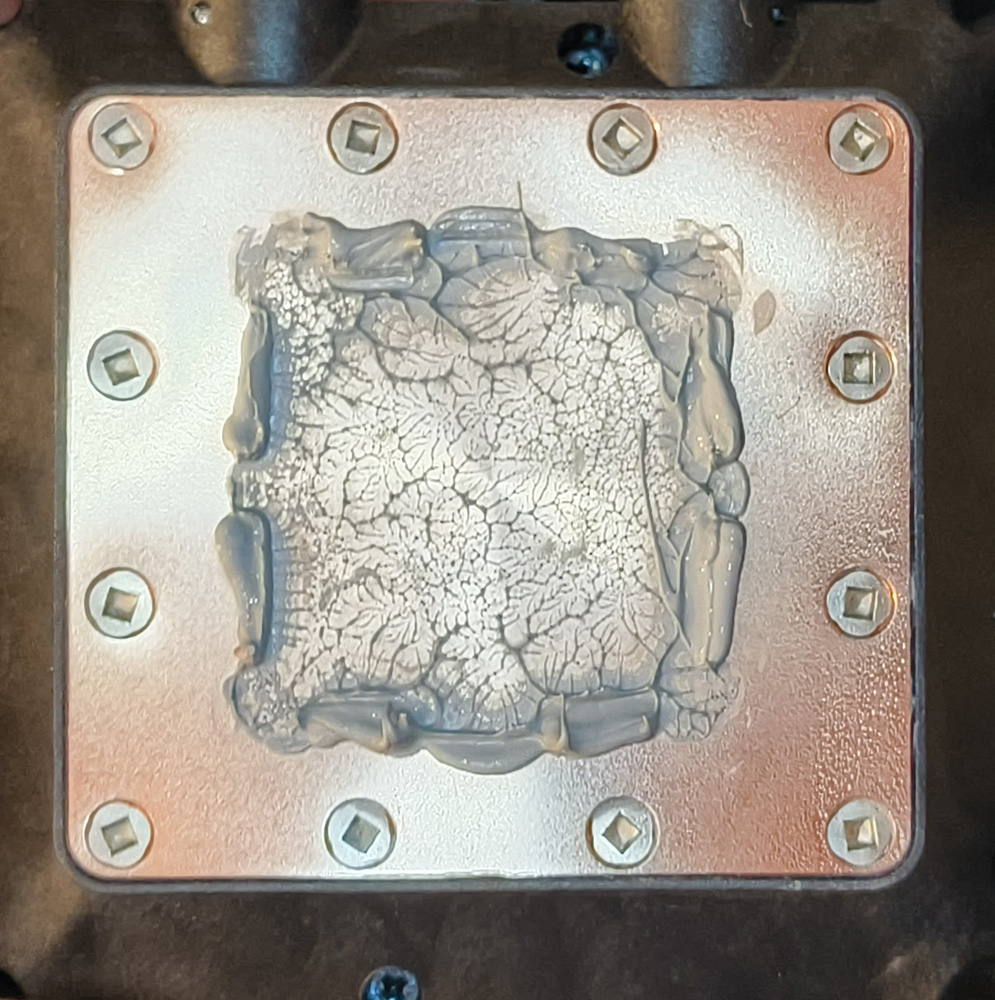
We then checked whether the paste had been distributed correctly – all three pastes worked perfectly. In this example, we had applied a little too much WLP, which then oozed out too much at the edges, but this did not affect the cooling performance.
It should be noted that the test results are not comparable to scientific work conducted under laboratory conditions. However, they provide a good representation of practical use. All of the following temperatures refer to the Tctl/Tdie value determined using HWiNFO.
Without further ado, here are the test results:
| Fan profile | Type of measured value | Arctic MX-4 | Arctic MX-6 | Arctic MX-7 |
|---|---|---|---|---|
| 25 % | Average | 77.1 °C | 77.2 °C | 77.0 °C |
| Maximal | 79.2 °C | 79.3 °C | 79.5 °C | |
| 50 % | Average | 69.6 °C | 69.4 °C | 69.3 °C |
| Maximal | 71.5 °C | 71.4 °C | 71.4 °C | |
| 75 % | Average | 67.0 °C | 66.9 °C | 66.2 °C |
| Maximal | 69.5 °C | 68.4 °C | 67.6 °C | |
| 100 % | Average | 66.7 °C | 66.6 °C | 66.7 °C |
| Maximal | 68.4 °C | 68.6 °C | 68.4 °C | |
| ASRock Silent Profile | Durchschnitt | 70.9 °C | 70.3 °C | 69.8 °C |
| Maximal | 71.2 °C | 71.0 °C | 70.5 °C |
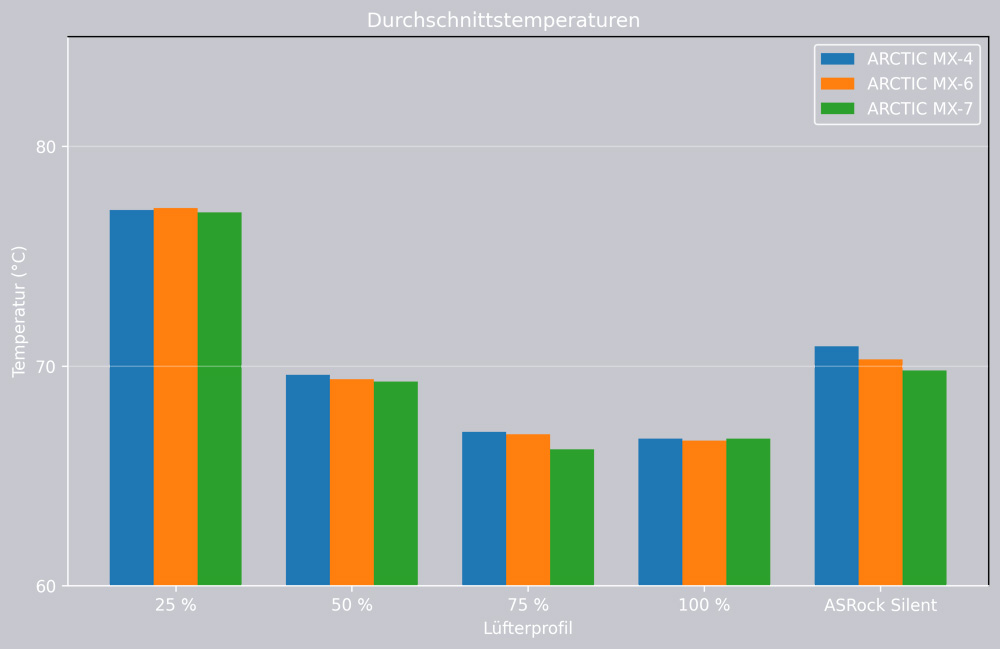
The measurement results show that Arctic MX-4, MX-6, and MX-7 perform at very similar temperature levels in this test. Across all fan profiles tested, the deviations between the individual thermal pastes are mostly in the range of a few tenths of a degree to a maximum of around 1 °C. Such small differences are hardly noticeable in practice and are within the range of what can also be caused by measurement tolerances or minimal differences in the application of the thermal paste.
It is striking that although the Arctic MX-7 achieves the lowest average temperatures in many scenarios – especially at 75% fan speed and in the ASRock Silent profile – its lead over MX-4 and MX-6 is very small overall. At full fan speed (100%), all three pastes are almost equal, which indicates that the influence of the thermal paste decreases significantly at maximum cooling performance. The maximum measured advantage of the MX-7 over the MX-4 in the test is less than 1 °C, which once again underlines the low influence of the thermal paste at moderate waste heat.
One possible reason for the overall very close results is the comparatively low power consumption of the CPU at around 120 watts. In this power range, heat dissipation does not pose a major challenge for modern cooling solutions. The thermal load is simply not high enough to clearly highlight any major differences between the thermal pastes tested.
Only at higher power consumption levels—such as with heavily overclocked processors or continuously high loads above 200 watts—could the design advantages of the MX-7, such as the improved formula and reduced pump-out effect, become more noticeable.
Arctic MX-7 Result and general impression …