

Practical testing …
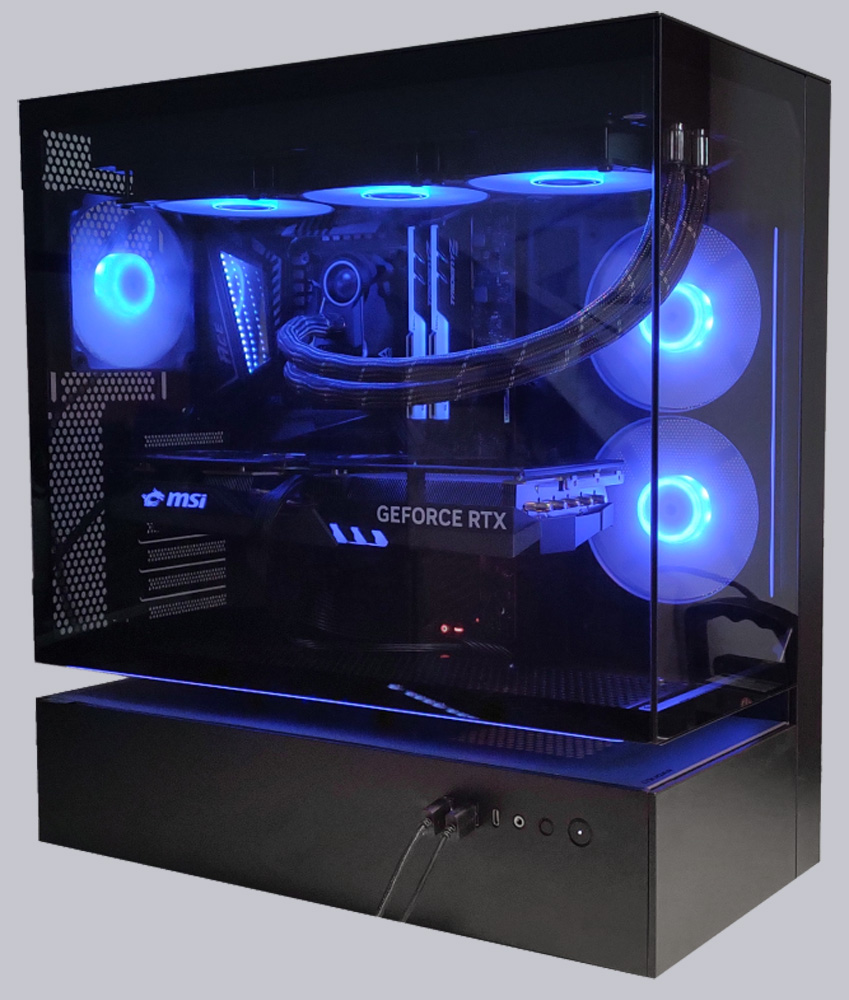
Thanks to the Cougar CFV235’s well-thought-out design, we were able to install the test system without any problems.
The test system:
MSI MEG ACE X570 motherboard
AMD Ryzen 5800X CPU
Arctic Liquid Freezer II 360 AIO
32GB G.Skill TridentZ RGB RAM
Samsung 970 Evo M.2 1TB SSD
MSI RTX 4070 Gaming X Trio graphics card
Chieftec Vega M 850W power supply
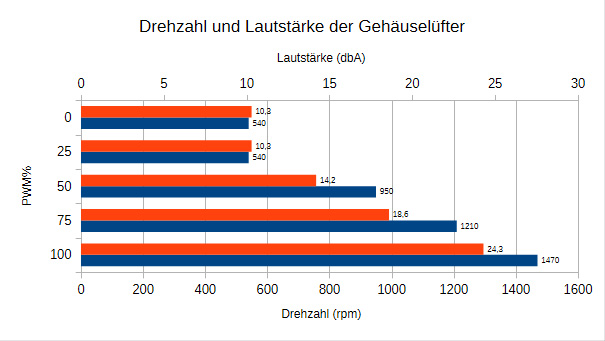
Note: All noise level measurements in this test were taken using a highly sensitive instrument microphone from a distance of 50 cm. For comparison, 10 dB corresponds to a completely silent room without any special soundproofing. 20 dB is the sound of audible breathing, while 30 dB is already a distracting hum or noise.
First, we took a closer look—and listened—to the pre-installed fans in terms of noise levels and were pleasantly surprised. Cougar’s 120mm fans are virtually inaudible at low speeds. Even though they do not support a Zero Fan mode and still spin at around 500 rpm even at 0% PWM, they are completely silent. But even at the maximum speed of around 1500 rpm, they remain exceptionally quiet at a measured 24.2 dB(A).
We then tested how well the pre-installed fan configuration was able to supply the system with sufficient cool air.
To do this, we pushed the CPU to its maximum capacity using the Prime95 stress test and pushed the graphics card to its limits using the Geeks3D Furmark GPU stress test. Under this load, the fans of the AIO and the graphics card each ran at maximum speed.
The case fans, on the other hand, were set to various PWM profiles ranging from 25% to 100% of maximum speed.
After every 10 minutes of the stress test, HWInfo64 was used to log the average temperature of the CPU cores (CPU Temp), the temperature at the voltage regulators (Chip Temp), and the system temperature (Sys Temp). It should be noted that these values come from sensors on the motherboard and are generally only approximate.
For reference, the same stress test was also performed on a benchtable using the same hardware. With an unlimited supply of fresh air, an average CPU temperature of 78°C and a chip temperature of 42°C were measured.
The results of the measurement with the pre-installed fan configuration.
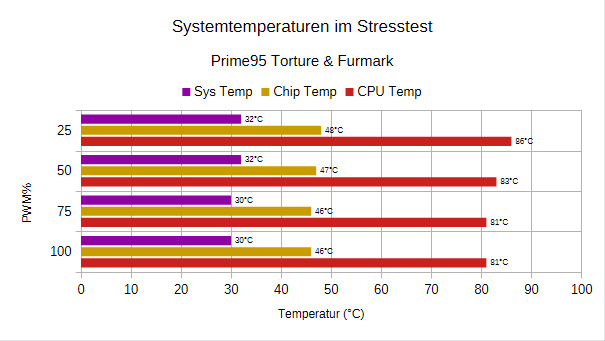
On a positive note, the CPU does not reach its temperature limit here even with the case fans barely running, although the measured temperature of 86°C is far from ideal.
Nevertheless, even at maximum speed, the case fans still show a significant temperature difference compared to the reference measurement on the Benchtable.
We therefore conducted another round of measurements with additional fans. For this test, we installed three Arctic P12 Pro Reverse fans in the case bottom and operated them with the same PWM settings as the Cougar case fans.
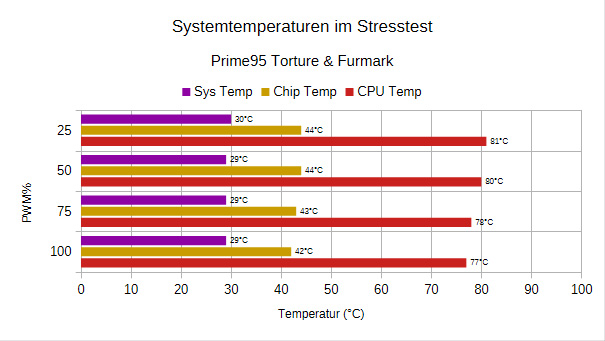
In this test, temperatures are almost consistently a few degrees lower than in a system without additional fans at the bottom. When all case fans are running at maximum speed, temperatures are even very similar to those on the benchtable.
Cougar CFV235 ARGB Lighting …