

|
Crucial 10th Anniversary 2GB Kit (2x1024MB) PC2-5300/DDR2-667
Memory Review
The introduction ...
The company Crucial should be well known by everyone who is interested in PC or Macintosh hardware and
already acquired some memory modules.
It's not only because of the high performance of the modules, but also because of the long existence
of the company.
Crucial recently became 10 years old and they celebrated their 10th anniversary with special chocolate modules
(yes, memory modules can be tasty) and
with special 10th Anniversary 1GB PC2-5300/DDR2-667 CL3 memory modules.
PC2-5300 does not sound very fast, but sometimes the test results differs from the first impression.
If you like to know more about the 10 years Crucial, you should take the time for their interactive Flash animation.
Thanks for the support ...
Many thanks for the support with the TY2KIT12864AA663 tenth
Anniversary 2GB PC2-5300/DDR2-667 CL3
kit by Crucial.
The 2 GB kit contains two 1024 MB 10th Anniversary 240-pin DIMM DDR2-667
memory modules and
the current price
is about 298 euro (11/2006).
They're available with the upper banner in the Crucial
Shop and at our sponsors.
The supply of the two 1024MB PC2-5300 memory modules ...
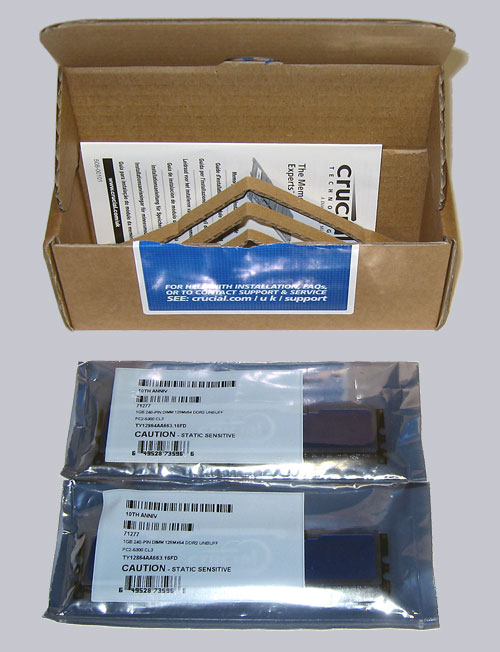
In this small box are the two very well protected memory
modules:
That is contained in the scope of delivery ...
Crucial supplies the two memory modules as well as a multilingual
installation guide, which should make it possible
also for less experienced users to install them easily:
The technical data ...
| Manufacturer |
Crucial |
| Article number |
TY2KIT12864AA663 / 2x TY12864AA663 |
| Memory |
2GB kit (1024MBx2) |
| Package |
Tenth Anniversary 240-pin DIMM |
| Type |
DDR2 PC2-5300 |
| Configuration |
128Meg x 64 |
| DIMM Type |
UNBUFFERED |
| Error correction |
NON-ECC |
| Speed |
DDR2 667 (333 MHz * 2) |
| Voltage |
2.2 Volt |
| Memory timing |
3-3-3-12 (Tcl-Trcd-Tras-Trp) |
Characteristics and other features ...
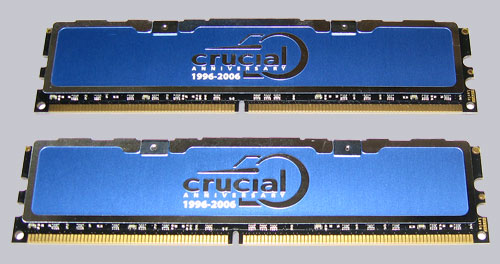
The memory modules are provided on a black plate with an embossed silver logo on the blue
aluminium passive heatsinks
(heatspreader)
which are supposed to
enhance the memory cooling also with higher frequencies and/or higher
voltages.
Thus one achieves on the one hand better results with overclocking and
on the other hand a longer life-time,
whereby Crucial by the way grants lifelong warranty (Limited Lifetime
Warranty) for the buyer
(all informations to manufacturer conditions are of course without guarantee
by ocinside.de).
Here's another picture of the nice 10 years Crucial modules ...

Benchmark values and test results ...
Let us begin with the most important part of the test report,
because the optics is of course rather secondary and
the possible stable performance is the most important factor.
The test results are based on an ASRock AM2XLI eSATA2 SLI motherboard
with an Athlon 64 Socket AM2 3000+
CPU on different frequencies depending on the reference clock for the
different memory benchmarks.
Thus the multiplier adjustment remains on 9x with all frequencies, because
an adjustment for the CPU in half multiplier
steps would be too inaccurate to get nearly the same CPU frequency for
all tests.
Microsoft Windows XP Professional SP2 is used as operating
system.
The stability was examined with the software Memtest86
and SiSoft Sandra
Lite 2007.SP1 program is used for all
benchmarks, since it offers extensive adjustments and a fast result comparison.
First the maximum possible frequency of the memory module
was determined.
The memory frequency was increased in small steps with a fixed memory
timing of 4-4-4-10 2T and default memory voltage, as long as the detailed
memory test with Memtest86 runs without any errors.
This quite long testing time ensured that this frequency works really
stable with these modules.
The highest possible frequency with 4-4-4-10 (Tcl Trcd
Tras Trp) timings was stable with amazing 451 MHz !
With increased voltages or lower timings it's possible
to run clearly higher frequencies, because the frequency values
and timings depends directly from each other.
This highest possible frequency was compared to two adjustments.
On the one hand 443 MHz with SPD values (these are given by the manufacturer
in the SPD IC),
and on the
other hand 200 MHz (x2) with SPD values.
Unfortunately the two modules could not be used with the highest possible frequency of 451 MHz with SPD values,
since those SPD EEPROM Timings were too fast with this very high frequency.
To that extent this benchmark value remains unfortunately empty.
By the way, the "Memory Bus Range" is no benchmark value, but
this value is quite simple to calculate by the
frequency and is useful for the benchmark comparison.
Here're the benchmark results:
|
Frequency
|
Timing
|
RAM Range Int Buff'd iSSE2
|
Memory bus range
|
|
451 MHz
|
fest (4-4-4-10 2T)
|
6309 MB/s
|
14432 MB/s
|
|
451 MHz
|
SPD (noboot)
|
-
|
-
|
|
200 MHz
|
SPD (4-3-3-9 2T)
|
4651 MB/s
|
6432 MB/s
|
Here's a diagram of the benchmark values:

Here is a direct benchmark result comparison of some DDR2 and DDR memory modules:

The result of the Crucial PC2-5300 CL3 memory is extraordinarily good, because in the direct compare to the
previously tested PC2-6400 CL4 modules they're clearly faster.
Despite lower frequency (PC2-5300 to PC2-6400) the modules achieve higher overclocking results due to the faster latency timings (CL3 to CL4).
Result and general impression ...
The Crucial 10th Anniversary 2GB PC2-5300 CL3 kit (TY2KIT12864AA663) is better overclockable than the
PC2-6400 CL4
pendant and they are thereby very useful for a very high FSB and/or reference clock.
High-End overclocker should not only pay attention to the highest
speed, but like always on the best combination
of frequency and Timings.
10 years Crucial were in any case worthwhile.
All pictures and article copyright 2006 www.ocinside.de
|